
Maybe you’re reading this after finding me at market and purchasing a Ginseng plant, or perhaps you’ve found one for sale elsewhere. Some plants seem a little intimidating when we’re first meeting them, and Ginseng is on that list for many of us. It’s kind of like making a new recipe in the kitchen though, it seems scary but once you’ve done it a few times, it’s a piece of cake! Well, I’m not sure if growing Ginseng is really ever described as a piece of cake, but it’s all about giving it what it needs (the right soil, amount of light, spacing, drainage), and keeping away what it doesn’t (predators, disease).
When planting your Ginseng plants, site selection is key. I’ve added the following excellent site selection info from the United Plant Savers website.
Ginseng is typically found growing on north, northeast, and east facing aspects under a mature forest canopy that provides approximately 75%-90% shade (Davis and Persons, 2014). Within these baseline conditions, Ginseng prefers sites with well-drained soils that are rich in organic matter yet maintain a slightly acidic soil pH (5.5–6.0) (Davis and Persons, 2014). Good soil drainage is essential for healthy Ginseng plantings. Ginseng is susceptible to several species of water-borne pathogens, and the accumulation of excess water in the growing site can contribute to the spread of diseases that can decimate Ginseng plantings. As we have previously discussed, planting sites with gentle to moderately sloped terrain will help facilitate soil drainage and can go a long way to helping keep your ginseng plantings healthy.
The presence of certain companion plants and other indicator species can also be used to identify and evaluate potential production sites. Species that are commonly found growing in association with Ginseng, include, but are not limited to, Tulip Poplar, Sugar Maple, Basswood, Black Walnut, Red Oak, Slippery Elm, White Ash, Spicebush, Trillium, Black Cohosh, Blue Cohosh, Goldenseal, Jack-in-the-pulpit, Maidenhair Fern, Rattlesnake Fern, and Bloodroot (Apsley and Carroll, 2013; Burkhart, 2013).
Soil calcium content has been shown to be highly beneficial to the growth and development of Ginseng plantings, contributing to increased root growth and disease resistance (Hankins, 2000). Evidence suggests that Ginseng plantings thrive in soils with calcium levels ranging from 2500–5000 lbs/acre (Beyfuss, unpublished). Many of the species listed above, such as, Tulip Poplar, Sugar Maple, Jack-in-the-pulpit, Rattlesnake Fern, and Maidenhair Fern (Burkhart, 2013), are all calcium loving species and can help you identify calcium-rich production sites. Phosphorus, which is used by plants to absorb and process calcium, is another important factor to consider during the site selection process. Phosphorus levels of 90 lbs/acre are recommended and can be augmented by supplementing with rock phosphate (Hankins, 2000).

Second year American Ginseng plant (seeds started in fall 2022)
One great thing about planting a nursery grown plant rather than a rootlet, is that you won’t need to worry about whether you’re planting deep enough, or too deep, because you’ll simply plant it so that the soil in the pot is flush with the soil you’re planting into. You’ll want to mulch with some nice light leaf material from a tree like Tulip Poplar or Maple, but most any deciduous tree leaf will do. I like to grind or smash my leaves up with my hands so they don’t cover the small plant, only the soil beneath it.
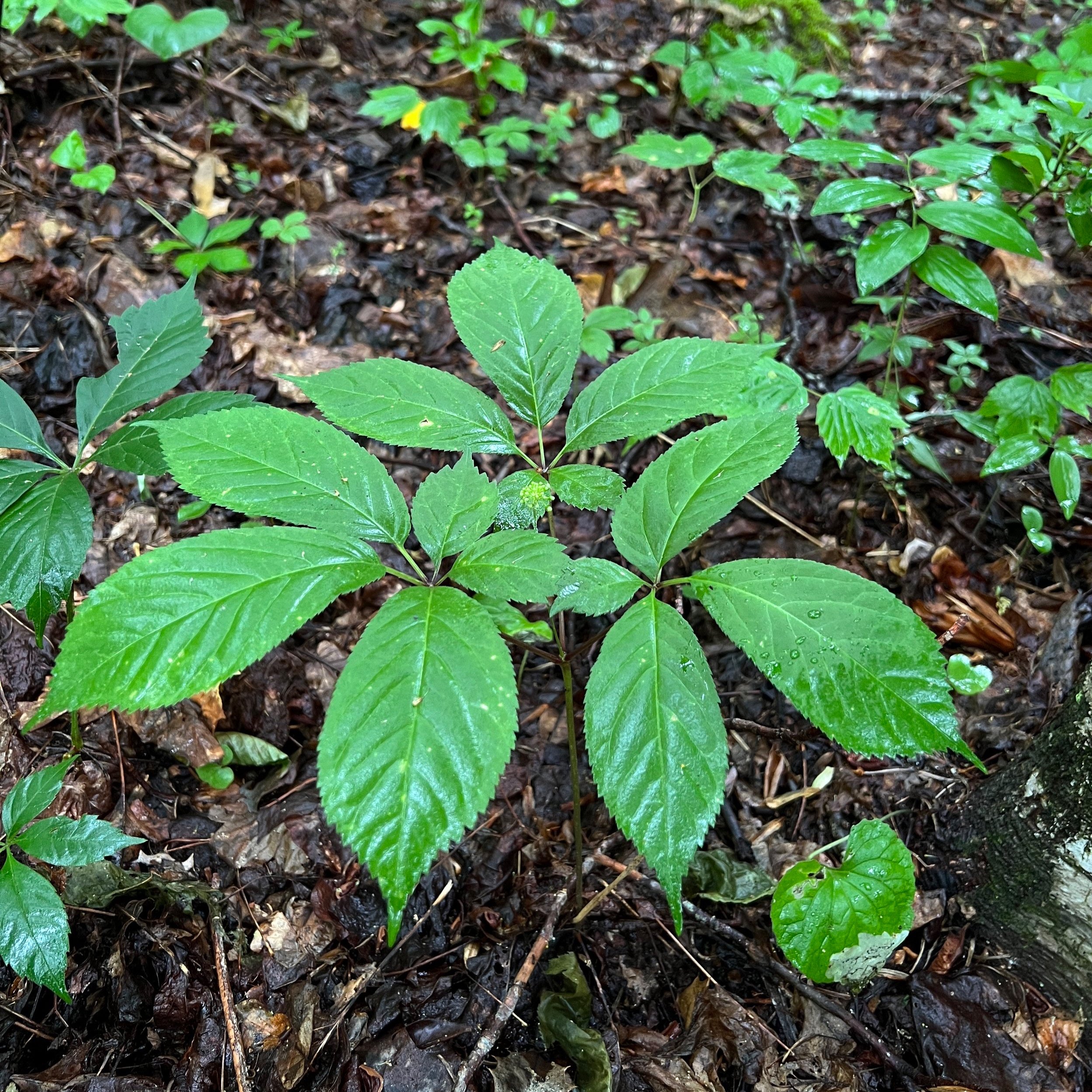
I prefer to plant when it’s nice and cool out, in the morning or the early evening, and bonus if it’s right before a rain. If rain isn’t coming within the hour, plan to water them in well (after mulching with leaves). Be sure to check on your plants so that they don’t get dried out as they’re becoming established, although if you’re planting where it wants to be planted, the soil should stay nice and moist under the forest canopy unless we have a serious drought (it could happen).
The picture above is a mature, seed producing Ginseng plant. You can expect to see your plant get to this stage in a year or three if all goes well (the plant you’ve purchased is probably two-three years old already). You’ll want to keep it protected if you have deer, rabbit, vole or slug pressure, or even pets that will step on it (learned this the hard way). You can use anything from fencing to fallen limbs to keep it protected. This is where we can get creative!
If your plant is protected from animals but declines over a year or two you might want to consider what isn’t right about the soil or location, or check for disease (Ginseng is very susceptible to fungal pathogens). You can always send in a soil test to the NC Cooperative Extension Service if you want to be sure about it, just be sure to check the appropriate box on the form so they know you’re testing forest soil for Ginseng, not field soil for tomatoes. Also, just as United Plant Savers mentions, planting in an area where there are indicator plants will darn near assure you’ve got a good spot.
Happy planting!!